Stepping into the world of microwave ovens can feel like navigating a culinary maze. For over a decade, my journey as an Admin at microwaveoventop.com has immersed me in the nuances of these essential kitchen appliances, from the simplest models to advanced technological marvels. My goal is to demystify the choices, helping you pinpoint the perfect microwave for your home or business needs and budget. Today, we’re diving deep into a crucial distinction often overlooked: the fundamental differences between commercial and residential microwaves.
While both types use electromagnetic waves to heat food, their design, construction, and performance are tailored for vastly different environments. A residential microwave is engineered for occasional home use, warming leftovers or preparing quick meals a few times a day. In stark contrast, a commercial microwave is a robust workhorse, built to withstand the relentless demands of a professional kitchen, running continuously for hundreds of uses daily. Understanding these core distinctions is paramount to making an informed decision that ensures efficiency, safety, and longevity, whether you’re outfitting a bustling restaurant or upgrading your home kitchen.
What is a Microwave Oven?
A microwave oven is an electric appliance that heats and cooks food by exposing it to electromagnetic radiation in the microwave frequency range. These microwaves cause polarized molecules in food, primarily water, to rotate and generate thermal energy through molecular friction. This process allows for rapid heating and cooking, making the microwave an indispensable tool in modern kitchens. The technology was accidentally discovered in the 1940s and quickly evolved into the household appliance we know today, continually adapting to new demands and applications.
Key Differences Between Commercial and Residential Microwaves
At first glance, a microwave might seem like a microwave, but the disparities between commercial and residential models are profound, akin to comparing a family car with a heavy-duty delivery truck. Each is engineered with specific purposes and operational demands in mind.
Usage and Durability
|
Our Picks for the Best Microwave oven in 2026
As an Amazon Associate I earn from qualifying purchases.
|
||
| Num | Product | Action |
|---|---|---|
| 1 | GASLAND 30 Inch Over-the-Range Microwave Oven, 1.7 Cu.Ft Over Stove Microwave, 1000W with 10 Power Levels, Sensor & One-Touch Cooking, 300 CFM Venting, LED Cooktop Light, Black Kitchen Microwave |

|
| 2 | COMFEE CMO-C20M1WH Retro Microwave with 11 power levels, Fast Multi-stage Cooking, Turntable Reset Function Kitchen Timer, Speedy Cooking, Weight/Time Defrost, Memory function, Children Lock, 700W |
|
| 3 | BLACK+DECKER EM720CB7 Digital Microwave Oven with Turntable Push-Button Door, Child Safety Lock, 700W, Stainless Steel, 0.7 Cu.ft |
|
| 4 | TOSHIBA EM131A5C-BS Countertop Microwave Ovens 1.2 Cu Ft, 12.4" Removable Turntable Smart Humidity Sensor 12 Auto Menus Mute Function ECO Mode Easy Clean Interior Black Color 1000W |
|
| 5 | TOSHIBA EM131A5C-SS Countertop Microwave Ovens 1.2 Cu Ft with 12.4" Removable Turntable Smart Humidity Sensor, 12 Auto Menus Mute Function ECO Mode Easy Clean Interior, 1000W, Silver |
|
| 6 | COMFEE' Retro Small Microwave Oven With Compact Size, 9 Preset Menus, Position-Memory Turntable, Mute Function, Countertop Perfect For Spaces, 0.7 Cu Ft/700W, Cream, AM720C2RA-A |
|
| 7 | Chefman Countertop Microwave Oven 0.7 Cu. Ft., 700 Watts with 10 Power Levels, 6 Cooking Presets with One-Touch Express Cook, Eco Mode, Child Safety Lock, & Mute Button - Black |
|
| 8 | COMFEE' EM720CPL-PMB Countertop Microwave Oven with Sound On/Off, ECO Mode and Easy One-Touch Buttons, 0.7cu.ft, 700W, Black |
|
| 9 | COMFEE' Retro Small Microwave Oven With Compact Size, 9 Preset Menus, Position-Memory Turntable, Mute Function, Countertop Microwave For Small Spaces, 0.7 Cu Ft/700W, Green, AM720C2RA-G |
|
| 10 | COMFEE' Retro Small Microwave Oven With Compact Size, 9 Preset Menus, Position-Memory Turntable, Mute Function, Countertop, Perfect For Small Spaces, 0.7 Cu Ft/700W, Red, AM720C2RA-R |
|
The most significant divergence lies in their intended usage and the durability of their construction. Residential microwaves are designed for light-duty, intermittent use, typically handling 3-5 cooking cycles per day. Their components are not built for continuous operation. Conversely, commercial microwaves are true industrial workhorses, designed to operate continuously for upwards of 200 cycles or more per day. They feature robust, heavy-gauge materials, often stainless steel for both interior and exterior, to withstand constant opening, closing, and rigorous cleaning in demanding professional environments.
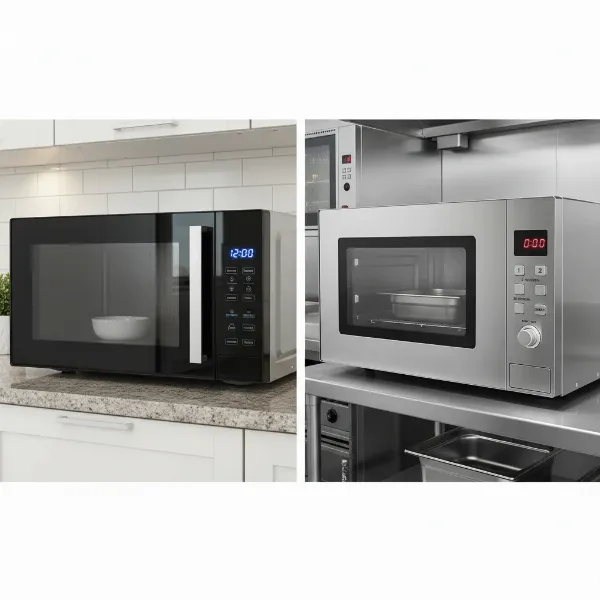 Side-by-side comparison of a sleek residential microwave and a robust stainless steel commercial microwave.
Power and Efficiency
Commercial microwaves typically boast significantly higher wattage than their residential counterparts, leading to faster cooking and greater efficiency. While residential models generally range from 600 to 1200 watts, commercial units start around 1000 watts and can soar to 3000 watts or even higher for heavy-duty models. This increased power translates directly to reduced cooking times, a critical factor in busy commercial kitchens where speed and consistency are paramount.
Cooking Mechanism and Evenness
Many residential microwaves utilize a rotating turntable to ensure even heating by moving the food through the microwave energy field. Commercial microwaves, however, often forgo the turntable in favor of a “stirrer” system. This system uses a fan or stirrer blade to evenly distribute microwave energy throughout the entire cavity, preventing hot spots and cold spots. This design also allows for full utilization of the interior space and accommodates larger, often irregularly shaped, professional food pans.
Capacity and Size
Commercial microwaves are generally larger and offer greater internal capacity to accommodate the high volume of food preparation required in food service. They are often sized to fit standard half-size or even full-size food pans, a necessity for heating larger batches of ingredients or complete dishes. Some commercial models even feature bottom-opening doors, which provide a convenient shelf for resting heavy pans, enhancing safety and workflow.
Controls and Programming
Residential microwaves often feature a wide array of pre-programmed settings for specific food types, sensor cooking, and sometimes smart connectivity. Commercial units prioritize simplicity, durability, and consistency. They typically offer fewer, larger buttons, often with programmable settings that allow staff to save precise time and power-level combinations for frequently prepared items. This streamlines operations, reduces errors, and ensures consistent results regardless of the operator.
Safety and Certifications
Safety and compliance are non-negotiable in commercial settings. Commercial microwaves are rigorously tested and certified by organizations like NSF International and Underwriters Laboratories (UL) to meet stringent public health and safety standards. These certifications are crucial for health code compliance and ensure the appliance is safe for operation in a high-demand environment. Using a residential microwave in a commercial kitchen not only voids its warranty but can also lead to health code violations and potential safety risks.
Warranty and Service
Manufacturer warranties are strictly tied to the intended use of the appliance. A residential microwave used in a commercial setting will almost certainly have its warranty voided. Commercial microwaves come with warranties specifically designed for heavy usage, often including on-site service and extended coverage for key components like magnetrons, reflecting their robust build and higher initial investment.
Types of Microwave Ovens: Commercial vs. Residential Focus
While the general categories of microwave ovens (solo, grill, convection) apply to both, the emphasis and feature sets differ significantly when comparing commercial and residential applications.
-
Residential (Home-Use) Microwaves:
- Solo Microwaves: The most basic and affordable, ideal for reheating, defrosting, and simple cooking tasks. Perfect for individuals or small families.
- Grill Microwaves: Combine microwave functions with a grilling element, allowing for browning and crisping food. Offers more versatility for home cooks.
- Convection Microwaves: The most advanced residential type, integrating a convection oven with microwave capabilities. This allows for baking, roasting, and combination cooking, making it a versatile second oven or space-saver. Features often include sensor cooking, inverter technology, and smart connectivity.
- Pros: Affordable, compact, wide range of aesthetic designs, advanced home-centric features, energy-efficient for light use.
- Cons: Not built for heavy use, slower heating, smaller capacity, warranties voided if used commercially.
-
Commercial Microwaves:
- Light-Duty Commercial Microwaves: Designed for low-volume commercial use, such as a small office breakroom or a café warming pastries occasionally. Still more durable and powerful than residential models.
- Medium-Duty Commercial Microwaves: Suitable for moderate volume kitchens, like convenience stores, snack bars, or smaller restaurants that use the microwave regularly but not constantly. Offers enhanced durability and power.
- Heavy-Duty Commercial Microwaves: The workhorses of bustling kitchens, including large restaurants, cafeterias, and institutional food service. Built for continuous, high-volume use with maximum power and robust construction. These often feature advanced programmable controls and stirrer systems.
- Pros: Extremely durable, fast and efficient heating, large capacity, designed for heavy continuous use, health code compliant, robust warranties.
- Cons: Higher upfront cost, less emphasis on aesthetic design, fewer “smart” features, often requires dedicated electrical circuits.
Detailed Comparison Table: Commercial vs. Residential Microwaves
| Feature | Residential Microwave | Commercial Microwave |
|---|---|---|
| Intended Use | Occasional home cooking, reheating | High-volume, continuous professional food service |
| Daily Usage | 3-5 times | 200+ times |
| Wattage | 600 – 1200 W | 1000 – 3000 W (up to 5000 W for heavy-duty) |
| Construction | Lighter materials, plastic components | Heavy-duty stainless steel (interior & exterior) |
| Heating Method | Turntable for even heating | Stirrer system for even energy distribution (no turntable) |
| Capacity | Smaller, fits standard dinner plates | Larger, accommodates full-size food pans |
| Controls | Varied, pre-set menus, sensor cooking, smart features | Simple, durable, programmable for consistency |
| Lifespan | 1-3 years (under commercial strain), 5-10 years (home) | 5-10+ years (under continuous commercial use) |
| Certifications | Standard consumer electronics safety | NSF, UL certified for public health and safety |
| Warranty | Voided if used commercially | Designed for commercial use, often includes on-site service |
| Price Range | ~$50 – ~$500+ | ~$300 – ~$3000+ |
| Electrical Needs | Standard 15A outlet | Often dedicated 15A or 20A circuits, higher voltage |
Leading Microwave Brands: A Look Through the Commercial/Residential Lens
While many brands produce both residential and commercial microwaves, their offerings in each category are distinctly different. When considering a purchase, it’s vital to assess a brand’s reputation within the specific segment you need.
For residential users, brands like Sharp, Panasonic, Electrolux, Samsung, and LG are well-known for their diverse range of stylish, feature-rich microwaves that integrate well into home kitchens. They offer everything from basic solo models to advanced convection and smart-enabled ovens, focusing on user convenience and aesthetic appeal.
In the commercial sphere, durability, power, and consistent performance take precedence. Brands such as Panasonic Commercial, Sharp Commercial, Amana Commercial (ACP, Inc.), and Vollrath are stalwarts. Panasonic Commercial units, for instance, are renowned for their efficiency and consistent, even cooking, often employing inverter technology for precise power delivery. Sharp Commercial focuses on user-friendly designs combined with high power and programmable settings crucial for busy operations. Amana Commercial (part of ACP, Inc.) is celebrated for building robust, powerful machines that can endure the most demanding kitchen environments, prioritizing sheer reliability. Vollrath microwaves are engineered for speed and efficiency, making them a strong choice for high-volume operations where consistent performance is key.
When evaluating brands, consider:
- Price vs. Value: Commercial units have a higher upfront cost, but their durability and efficiency offer better long-term value.
- Targeted Features: Does the brand’s offering align with your specific needs (e.g., programmable settings for a café, high wattage for a restaurant)?
- Warranty and Support: Commercial brands typically offer comprehensive warranties and professional service networks vital for businesses.
How to Choose the Right Microwave Oven
Selecting the perfect microwave, whether for your home or a professional kitchen, requires a careful assessment of your specific needs. Here’s a detailed guide to help you make an informed decision.
1. Define Your Usage Needs
- Frequency: How often will the microwave be used daily? Occasional reheating at home? Or constant, back-to-back use in a commercial setting? This is the most crucial differentiator.
- Volume: For home, how many people will use it? For commercial, how many items need to be heated simultaneously, and what size are those items? Will you be heating single servings or large food pans?
- Primary Tasks: Will it mainly defrost and reheat, or will you need it for complex cooking, steaming, or even baking (e.g., with convection features)?
2. Consider Key Factors
- Wattage (Power): Higher wattage means faster cooking. For residential, 900-1200W is common. For commercial, 1500-2200W or more is often required for efficiency during peak hours.
- Capacity (Size): Measured in cubic feet. Residential units typically range from 0.7 to 2.2 cu ft. Commercial units are usually larger, starting around 1.0 cu ft and going up to 2.5 cu ft or more, designed to fit professional cookware.
- Durability and Construction: For commercial use, look for stainless steel interiors and exteriors that can withstand heavy use and are easy to clean. Residential units vary widely in material quality.
- Features:
- For Residential: Sensor cooking (automatically adjusts time), inverter technology (consistent power for even cooking), pre-set programs, smart features, convection/grill options.
- For Commercial: Programmable memory settings, multiple power levels, simpler, robust controls (dials or touchpads), stirrer system (no turntable), stackable design, bottom-opening doors.
- Safety Certifications (Commercial): Ensure the unit is NSF and UL certified for health and safety compliance in professional kitchens.
- Electrical Requirements (Commercial): Commercial microwaves often require dedicated circuits (e.g., 15-amp or 20-amp) and specific voltage (e.g., 208V or 240V) that differ from standard residential outlets. Always check product specifications and consult an electrician if needed.
- Brand and Warranty: Research brand reputation for the specific type of microwave you need. Understand the warranty terms; residential warranties are voided if used commercially.
3. Read Technical Specifications and User Reviews
Always review the detailed specifications to ensure the microwave meets your technical requirements (dimensions, power, electrical needs). User reviews offer practical insights into performance, durability, and ease of use from actual owners. For commercial purchases, seek reviews from other business owners in similar industries.
4. Tips for Before You Buy
- Measure Your Space: Accurately measure the height, width, and depth of the intended installation spot, allowing for adequate ventilation clearance (usually a few inches around the unit).
- Set a Realistic Budget: Commercial microwaves involve a higher upfront investment but offer better long-term value through durability and efficiency. Consider financing options if initial cost is a concern for a business.
- Consider Installation: For commercial units, confirm your kitchen’s electrical infrastructure can support the new appliance to avoid unexpected upgrade costs.
Useful Features of Microwave Ovens
Modern microwaves, both residential and commercial, come packed with features designed to enhance convenience and performance.
- Reheating, Defrosting, and Cooking Functions: The core capabilities of any microwave. Commercial units excel in speed and consistency for these basic tasks.
- Automatic Cooking Modes: Pre-programmed settings for common foods (popcorn, baked potato, pizza). Residential models often have more extensive lists, while commercial models focus on programmable “one-touch” settings for specific menu items to ensure consistency.
- Timer and Child Lock: Standard safety and convenience features found in most models.
- Inverter Technology: Found predominantly in higher-end residential and many commercial Panasonic models, inverter technology provides a continuous, consistent power flow. This results in more evenly cooked food, preserved texture, and faster defrosting without overcooking edges.
- Sensor Cooking (Residential): Automatically detects humidity released by food and adjusts cooking time and power level, preventing over or under-cooking.
- Combination Cooking (Residential): In convection microwaves, combines microwave energy with convection heat for faster cooking with browning and crisping results.
- Stirrer System (Commercial): Replaces a turntable, ensuring even distribution of microwave energy across the entire cavity, ideal for large or irregularly shaped items.
- Heavy-Duty Door Latches (Commercial): Built to withstand thousands of openings and closings, ensuring longevity and safety.
Cleaning and Maintaining Your Microwave Oven
Proper cleaning and maintenance are crucial for extending the lifespan of your microwave, ensuring hygiene, and maintaining optimal performance. This is especially vital for commercial units operating under strict health codes.
Daily Cleaning (Both Types, Crucial for Commercial)
- Wipe Down Interior: After each day’s use (or as needed in commercial settings), wipe out loose crumbs and food splatters with a damp cloth and mild soap. Stainless steel interiors in commercial units are particularly easy to clean.
- Clean the Door: Don’t forget the door interior and exterior, including the seal, to prevent food buildup and ensure proper closure.
- Dry Thoroughly: Always dry the interior completely to prevent moisture buildup, which can lead to odors or rust.
Monthly Deep Cleaning
- Steam Clean: Place a microwave-safe bowl with a 50/50 mix of water and white vinegar (or lemon juice) inside the microwave. Heat for 3-5 minutes until steaming. The steam will loosen cooked-on grime, making it easy to wipe away.
- Tackle Tough Stains: For stubborn grease, a paste of baking soda and water or a specialized microwave cleaner can be effective.
- Clean Exterior: Wipe down the outside with a non-abrasive cleaner suitable for the finish (e.g., stainless steel cleaner for commercial units).
Maintenance Tips for Longevity
- Inspect Door Seal: Regularly check the door seal for any cracks, tears, or damage that could allow microwave energy to leak, compromising safety and efficiency.
- Ensure Ventilation: Make sure the microwave’s vents are not blocked to prevent overheating. Commercial units require specific clearance for proper airflow.
- Use Microwave-Safe Cookware: Never use metal or aluminum foil in a microwave, as it can cause arcing, damage the unit, and create a fire hazard. Educate staff on this critical rule in commercial settings.
- Respect Capacity Limits: Avoid overloading the microwave, as this can lead to uneven cooking and put undue strain on the components.
- Professional Servicing (Commercial): Schedule regular professional maintenance for commercial units to identify and fix potential issues before they cause major downtime.
Safety Notes for Microwave Use
Microwaves are generally safe appliances, but adherence to safety guidelines is essential to prevent accidents and ensure long-term functionality.
- Avoid Metal Objects: As mentioned, never place metal, aluminum foil, or dishes with metallic trim inside the microwave.
- Proper Placement: Ensure the microwave is placed on a stable, level surface, away from heat sources and with adequate ventilation space around it. Do not block air vents.
- Supervise Cooking: Do not leave the microwave unattended, especially when heating liquids, which can superheat and erupt.
- Check for Damage: If the microwave door is bent, the hinges are broken, or the interior is damaged, discontinue use immediately and seek professional repair.
- Professional Repair Only: Do not attempt to repair a microwave yourself, particularly components like the magnetron, as they contain high-voltage capacitors that can be extremely dangerous even when unplugged. Always contact a qualified technician.
- No Sealed Containers: Avoid heating sealed containers or whole eggs, as pressure buildup can cause them to explode.
Conclusion: Choosing Your Ideal Microwave
The decision between a commercial and residential microwave hinges entirely on your specific environment and usage demands. For the average homeowner, a residential microwave offers an affordable, feature-rich, and aesthetically pleasing solution for everyday cooking and reheating. These models are designed for convenience and integrate seamlessly into a home kitchen, with features like sensor cooking and smart connectivity enhancing the user experience.
However, for professional kitchens, restaurants, cafes, or any environment requiring high-volume, continuous operation, investing in a commercial microwave is not merely a choice but a necessity. Their superior power, robust construction, specialized heating mechanisms, and adherence to safety certifications ensure speed, efficiency, and longevity under demanding conditions. While the upfront cost is higher, a commercial unit delivers a far greater return on investment through reduced downtime, consistent performance, and compliance with health regulations.
Ultimately, whether you need a dependable companion for quick family meals or a high-performance workhorse for a bustling culinary operation, understanding the profound differences between commercial and residential microwave ovens will guide you to the perfect appliance that meets your needs, budget, and expectations for years to come.
Frequently Asked Questions
Can I use a residential microwave in a commercial kitchen to save money?
It is strongly advised against using a residential microwave in a commercial kitchen. Residential units are not built for the continuous, heavy-duty use of a commercial setting and will likely fail quickly. More importantly, they lack the necessary safety and sanitation certifications (like NSF and UL) required for commercial operations, which can lead to health code violations, safety risks, and immediately void the manufacturer’s warranty.
How much more powerful is a commercial microwave compared to a residential one?
Commercial microwaves are significantly more powerful. While typical residential models range from 600-1200 watts, commercial microwaves generally start at 1000 watts and can go up to 3000 watts or even 5000 watts for heavy-duty units. This higher wattage allows for much faster and more efficient heating, crucial for high-volume environments.
Why don’t commercial microwaves have turntables?
Many commercial microwaves utilize a “stirrer” system instead of a turntable. This system distributes microwave energy evenly throughout the entire oven cavity, ensuring consistent heating without the need for food rotation. This design also maximizes internal space, allowing for larger, rectangular food pans common in professional kitchens.
What are the key indicators of a durable commercial microwave?
Look for a robust construction featuring stainless steel for both the interior and exterior, as this material withstands heavy use and is easy to clean. Heavy-duty door latches, simplified yet programmable controls designed for frequent interaction, and industrial-grade internal components are also strong indicators of a durable commercial unit built for longevity.
How do commercial microwave warranties differ from residential ones?
Commercial microwave warranties are specifically designed to cover the rigorous demands of professional use, often including longer coverage periods and specialized on-site repair services. In contrast, residential microwave warranties are typically voided if the appliance is used in a commercial or non-residential setting, as it operates outside its intended design parameters.