Embarking on an RV adventure often means trading spacious home kitchens for compact, mobile setups. While the open road offers unparalleled freedom, meal preparation in a confined space can present unique challenges. Many RVers find factory-installed microwaves to be underpowered or simply too large, leading to frustration and culinary limitations. Fortunately, the right compact microwave oven can revolutionize your mobile kitchen, offering convenience, versatility, and efficient cooking without hogging precious space or draining your power reserves.
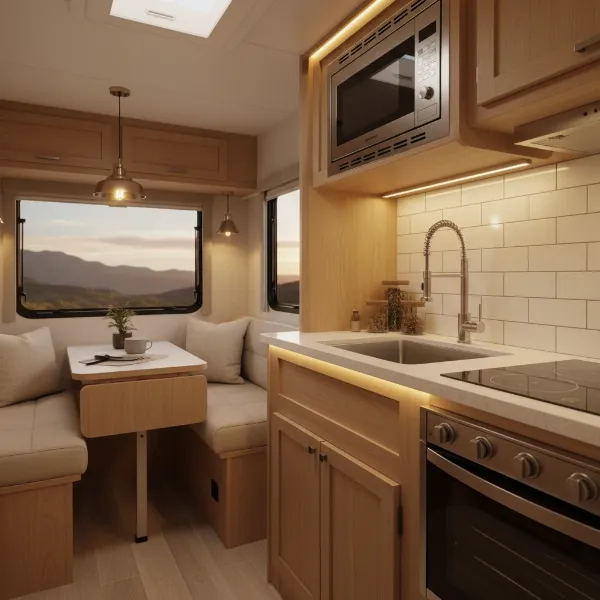 A compact microwave oven perfectly integrated into a modern RV kitchen interior with wooden cabinets.
This guide will navigate you through the world of compact microwaves specifically designed for RVs and campers. We’ll explore the distinct features that set them apart from their household counterparts, delve into crucial considerations like power consumption and installation, and highlight top models to help you find the perfect appliance for your nomadic lifestyle.
What Makes an RV Microwave Different?
You might wonder if a standard kitchen microwave could simply be placed in an RV. While seemingly similar, RV microwaves are purpose-built to handle the unique demands of life on the road. It’s not just about their smaller footprint; these appliances are engineered for durability, power efficiency, and safe operation in a moving vehicle.
Firstly, standard household microwaves are not designed to withstand constant vibration and movement, which can quickly lead to loosening components and premature failure. RV-specific models feature reinforced construction and secure mounting mechanisms to ensure longevity. Secondly, power management is critical in an RV. Conventional microwaves can draw significant power, potentially overwhelming limited electrical systems or rapidly depleting battery banks. RV microwaves are often optimized for lower wattage or designed to integrate seamlessly with RV power setups, including inverters and generators. Lastly, ventilation is a more complex consideration in compact RV kitchens, requiring units that operate efficiently without causing excessive heat buildup in confined spaces.
Types of Compact Microwaves for RV Spaces
When selecting a microwave for your RV or camper, you’ll encounter a few primary types, each with its own benefits suited to different needs and space constraints.
Countertop Microwaves
|
Our Picks for the Best Microwave oven in 2026
As an Amazon Associate I earn from qualifying purchases.
|
||
| Num | Product | Action |
|---|---|---|
| 1 | COMFEE' Retro Small Microwave Oven With Compact Size, 9 Preset Menus, Position-Memory Turntable, Mute Function, Countertop Perfect For Spaces, 0.7 Cu Ft/700W, Cream, AM720C2RA-A |

|
| 2 | Chefman Countertop Microwave Oven 0.7 Cu. Ft., 700 Watts with 10 Power Levels, 6 Cooking Presets with One-Touch Express Cook, Eco Mode, Child Safety Lock, & Mute Button - Black |
|
| 3 | COMFEE' Retro Small Microwave Oven With Compact Size, 9 Preset Menus, Position-Memory Turntable, Mute Function, Countertop, Perfect For Small Spaces, 0.7 Cu Ft/700W, Red, AM720C2RA-R |
|
| 4 | GASLAND 30 Inch Over-the-Range Microwave Oven, 1.7 Cu.Ft Over Stove Microwave, 1000W with 10 Power Levels, Sensor & One-Touch Cooking, 300 CFM Venting, LED Cooktop Light, Black Kitchen Microwave |
|
| 5 | BLACK+DECKER EM720CB7 Digital Microwave Oven with Turntable Push-Button Door, Child Safety Lock, 700W, Stainless Steel, 0.7 Cu.ft |
|
| 6 | TOSHIBA EM131A5C-BS Countertop Microwave Ovens 1.2 Cu Ft, 12.4" Removable Turntable Smart Humidity Sensor 12 Auto Menus Mute Function ECO Mode Easy Clean Interior Black Color 1000W |
|
| 7 | COMFEE CMO-C20M1WH Retro Microwave with 11 power levels, Fast Multi-stage Cooking, Turntable Reset Function Kitchen Timer, Speedy Cooking, Weight/Time Defrost, Memory function, Children Lock, 700W |
|
| 8 | TOSHIBA EM131A5C-SS Countertop Microwave Ovens 1.2 Cu Ft with 12.4" Removable Turntable Smart Humidity Sensor, 12 Auto Menus Mute Function ECO Mode Easy Clean Interior, 1000W, Silver |
|
| 9 | COMFEE' EM720CPL-PMB Countertop Microwave Oven with Sound On/Off, ECO Mode and Easy One-Touch Buttons, 0.7cu.ft, 700W, Black |
|
| 10 | COMFEE' Retro Small Microwave Oven With Compact Size, 9 Preset Menus, Position-Memory Turntable, Mute Function, Countertop Microwave For Small Spaces, 0.7 Cu Ft/700W, Green, AM720C2RA-G |
|
These freestanding units offer the most flexibility. They can be placed on any stable surface, moved as needed, or even stored away when not in use, making them ideal for smaller campers or those who only use a microwave occasionally. Countertop models typically plug into a standard 110-volt AC outlet. Their portability means easy setup at powered sites, but they might lack the secure, built-in feel some RVers prefer.
Built-in Microwaves
Integrated into your RV’s cabinetry, built-in microwaves provide a seamless, finished look and conserve countertop space. They are securely mounted, reducing movement during travel, and often feature trim kits to hide wiring and sides. Many built-in units are designed to vent air efficiently from the front, allowing for installation in enclosed spaces. These are an excellent choice for a more permanent kitchen setup. Over-the-range (OTR) models, a subset of built-in microwaves, combine microwave functionality with a range hood, offering dual utility in larger RVs where space allows for such an installation.
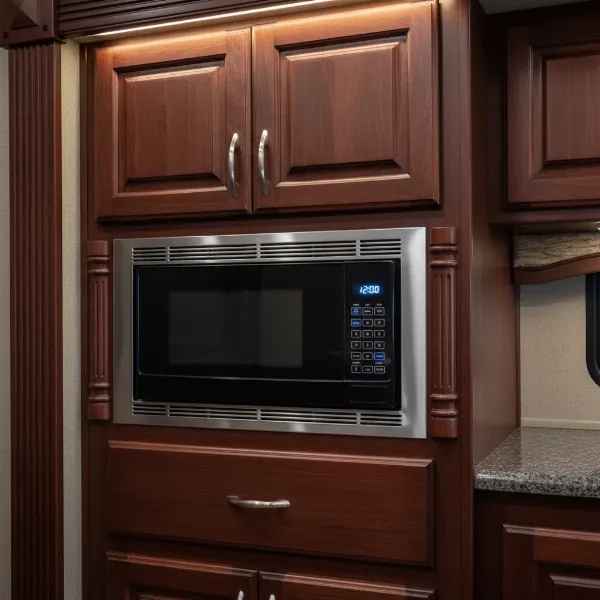 A securely installed built-in microwave oven integrated seamlessly into an RV's custom cabinetry.
Convection/Combination Microwaves
A game-changer for many RV kitchens, convection microwaves offer dual functionality: traditional microwave heating and convection oven capabilities. This means they can not only reheat leftovers but also bake, roast, and even crisp foods by circulating hot air, potentially eliminating the need for a separate oven. Some advanced models also include air fryer or grill functions, maximizing cooking versatility in a single compact appliance. While often more expensive and consuming more power in convection mode, their multi-functional nature can free up valuable space by consolidating several kitchen appliances into one.
Key Features to Consider When Choosing Your RV Microwave
Selecting the best microwave for your RV involves more than just picking the smallest unit. Here are the essential factors to weigh for optimal performance and convenience on the road:
Size and Capacity
Space is king in an RV. Compact models typically range from 0.5 to 1.5 cubic feet. While a 0.7 cubic foot unit might be sufficient for reheating a single plate, a 0.9 to 1.1 cubic foot model offers more versatility for standard dinner plates and small cooking tasks. Always measure your available cabinet or counter space meticulously, considering both external dimensions and interior capacity to ensure it fits your physical space and culinary needs.
Wattage and Power Consumption
This is arguably the most critical factor for RV use. Microwaves for RVs commonly have an output wattage between 700 and 1100 watts. However, the actual power draw is significantly higher than the output wattage due to efficiency losses; a 700-watt microwave, for instance, may draw upwards of 1200 watts from your electrical system.
Understanding this distinction is crucial for battery and inverter sizing. Look for “inverter microwaves” which can more efficiently modulate power draw rather than just pulsing full power on and off. Ensure your RV’s electrical system, especially if running on battery power through an inverter, can handle the microwave’s peak draw, particularly its high startup wattage.
Installation Type
Decide whether a countertop, built-in, or over-the-range model suits your RV’s layout and your cooking habits. Countertop units offer flexibility, while built-in options save space and provide a more integrated look. Over-the-range models are excellent for larger RVs that can accommodate their size and ventilation requirements, doubling as a range hood.
Special Features
- Turntable vs. Flatbed: A turntable ensures even heating, but a flatbed design can be easier to clean and provides more usable interior space, allowing for larger, rectangular dishes. Flatbeds can also be more stable during travel.
- Pre-programmed Settings: Features like one-touch buttons for popcorn, beverages, or specific foods can simplify cooking.
- Child Safety Lock: An important feature for families traveling with children, preventing accidental operation.
- Multi-functionality: As discussed, convection, air fryer, and grill features can enhance your cooking capabilities exponentially, turning a simple microwave into a versatile cooking station.
- ECO Function: This feature can help reduce standby power consumption, saving precious battery life when off-grid.
Durability and Build Quality
RV life involves bumps, vibrations, and temperature fluctuations. Choose a microwave from a reputable brand known for producing durable appliances designed for mobile environments. Stainless steel interiors are often easier to clean and more robust.
Top Picks: Best Compact Microwaves for RVs and Campers
Selecting from the myriad options can be daunting. Here’s a comparison of some highly-regarded compact microwave models that cater to diverse RV needs:
| Model | Type | Capacity (Cu. Ft.) | Key Features | Pros | Cons |
|---|---|---|---|---|---|
| Contoure RV-200S-CON Smart Air-Fry Convection | Built-in (Multi-function) | 1.0 (approx.) | Microwave, Convection, Air Fryer functions; Smart settings | Replaces multiple appliances; High versatility; Modern design | Higher price point; May require specific installation space |
| High Pointe 520EM925AWWB | Built-in (Standard) | 0.9 | Turntable; Optimized for RV power; Straightforward controls | Reliable performance; Affordable; Easy OEM replacement for many RVs | Basic features; No convection or air fry |
| SMETA Small Countertop Microwave | Countertop | 0.7 | 10 power levels; Child safety lock; Compact form-factor | Ultra-compact; Good for small RVs/travel trailers; Very portable | Lower wattage (700W) means longer cooking times; Limited features |
| Sharp R1874T | Over-the-Range (Convection) | 1.1 | Convertible venting; CompuBake/Broil/Roast programs; 13-inch turntable | Versatile cooking (bake, roast, grill); Spacious interior for its type | Larger footprint for an OTR; Higher power draw for convection modes |
| Daewoo Compact Digital Control 700W | Countertop | 0.7 | Digital controls; 7 power levels; Fits standard plate | Extremely compact; Reliable brand; Good value; Easy to clean | Basic functionality; Lower wattage |
Understanding RV Power Systems for Your Microwave
Running a microwave in an RV, especially off-grid, requires careful consideration of your power system. A typical 700-watt microwave can draw around 1200 watts. To run such an appliance reliably from your batteries, you’ll need:
- Inverter: A pure sine wave inverter is often recommended, with a continuous output of at least 1500 watts, and preferably 2000 watts, to handle the microwave’s startup surge and continuous draw.
- Battery Bank: For occasional microwave use, a 100Ah lithium (LiFePO4) battery or a 250Ah AGM battery (12-volt equivalent) is a good starting point. For more frequent cooking, especially with convection functions, a larger battery bank (e.g., 200-300Ah LiFePO4) is essential.
- Generator: When connected to shore power or a generator, most compact RV microwaves will operate without issue. Ensure your generator can handle the microwave’s wattage along with other simultaneous loads.
- Load Management: Be mindful of other appliances drawing power. You may need to temporarily turn off high-draw items like air conditioners or electric water heaters when using the microwave to prevent tripping breakers or overloading your system.
“Microwaves consume a lot of power to start up. Batteries also power down faster when more amps are drawn.” – Enjoybot, Battery Experts
Installation, Maintenance, and Safety Tips
Proper care ensures your RV microwave serves you well for many adventures.
- Secure Mounting: For built-in or over-the-range units, always use the manufacturer-specified mounting hardware and ensure it’s securely fastened to withstand road vibrations. Regularly check for any loosening.
- Ventilation: Never block ventilation openings. Ensure adequate clearance around the microwave to prevent overheating, especially in enclosed cabinetry.
- Cleaning: Regularly clean the interior, turntable, and door seals with mild soap and water. For stubborn odors, a bowl of water with lemon juice or vinegar microwaved for a few minutes can help.
- Safe Usage:
- Avoid using metal containers or foil, which can cause arcing and damage.
- Use microwave-safe dishes and covers.
- Never operate a microwave if the door is damaged or doesn’t close properly.
- Do not attempt to repair a malfunctioning microwave yourself; consult a qualified technician.
Conclusion: Choosing the Right Microwave for Your Mobile Kitchen
A high-quality compact microwave is more than just a convenience; it’s an essential upgrade that can significantly enhance your RV cooking experience. From quick reheats to gourmet meals prepared with convection functions, the right microwave can transform your mobile kitchen into a hub of culinary possibilities. When making your choice, prioritize size, power efficiency, installation type, and features that align with your travel style and cooking habits.
By carefully considering these factors and opting for models designed for RV life, you can invest in an appliance that brings reliable performance, safety, and versatility to your adventures for years to come. Don’t let a subpar microwave hold back your on-the-road dining. What culinary creations are you most excited to prepare in your newly optimized RV kitchen?
Frequently Asked Questions
What wattage microwave is best for an RV?
For most RVs, a microwave with an output wattage between 700 to 900 watts is generally considered best for balancing cooking efficiency with power consumption. These wattages are effective for common tasks like reheating and defrosting without excessively straining the RV’s electrical system, especially when running off an inverter or generator.
Can I use a regular microwave in my RV?
While you technically can use a regular household microwave in an RV, it’s generally not recommended. Household units are not designed to withstand the vibrations and movement of travel, and their power draw might be higher than what an RV’s electrical system can efficiently handle, especially off-grid. RV-specific microwaves are built for durability and optimized for mobile power limitations.
How do I run a microwave off my RV battery?
To run a microwave off your RV battery, you need a sufficiently large battery bank (e.g., 100Ah+ lithium or 250Ah+ AGM) and a pure sine wave inverter with adequate wattage (typically 1500W to 2000W continuous output). The inverter converts your battery’s DC power to AC power for the microwave. Always calculate the microwave’s actual power draw (input wattage) and ensure your system can handle it, including startup surges.
What’s the difference between a convection microwave and a standard one?
A standard microwave heats food using electromagnetic radiation. A convection microwave combines this with a fan and heating element that circulates hot air, similar to a conventional oven. This dual functionality allows convection microwaves to not only reheat but also bake, roast, and crisp foods, providing greater cooking versatility in a single appliance.
Are 12V RV microwaves a good option?
12V microwaves can run directly from your RV’s battery system, but they typically have drawbacks. They tend to be less powerful, slower, and more expensive than 110V/240V AC models. They also draw a significant amount of current, requiring robust cabling and potentially depleting your battery quickly if used regularly. Many RVers opt for a low-wattage 230V microwave paired with a suitable inverter instead.