Imagine a kitchen without a microwave oven – for many, it’s almost unthinkable. This ubiquitous appliance, responsible for everything from quickly reheating leftovers to defrosting dinner, has become an indispensable part of modern life. Yet, its journey from a cutting-edge military technology to a household staple is a fascinating tale of accidental discovery, relentless innovation, and evolving consumer needs. This article delves into the surprising history of the microwave oven, tracing its origins from the battlefields of World War II to the countertops of millions of homes worldwide. Prepare to uncover the unexpected path that transformed a powerful radar component into one of our most convenient kitchen companions.
The Spark of Genius: Percy Spencer and the Accidental Discovery
The story of the microwave oven begins not in a culinary laboratory, but with an American self-taught engineer named Percy Spencer. Working for Raytheon, a major defense contractor during World War II, Spencer was a brilliant inventor renowned for his expertise in radar technology and magnetron tubes. Magnetrons were vital components in radar systems, generating the microwaves used to detect enemy aircraft and ships.
In 1945, while working on an active magnetron, Spencer noticed something peculiar: a chocolate bar in his pocket had melted. Intrigued by this unusual phenomenon, he immediately recognized the potential of this energy. His subsequent experiments involved placing other food items, like popcorn kernels, near the magnetron, which quickly popped. The crucial insight was that the microwaves were directly heating the food from within, a stark contrast to conventional cooking methods. This accidental discovery marked the birth of microwave cooking.
 Percy Spencer discovering microwave heating with a magnetron and melting chocolate bar.
From Industrial Giant to Commercial Debut: The Radarange
Armed with Spencer’s groundbreaking observation, Raytheon quickly began developing an appliance to harness this new cooking method. In 1947, the first commercial microwave oven, aptly named the “Radarange,” was introduced. However, this early iteration was a far cry from the compact units we know today. The Radarange was an immense, refrigerator-sized machine, standing over 5 feet tall and weighing approximately 750 pounds. Its formidable size and a hefty price tag—ranging from $2,000 to $3,000, which translates to tens of thousands of dollars in today’s money—meant it was impractical for home use.
Consequently, the initial market for the Radarange was primarily industrial. It found applications in restaurants, railway dining cars, and ocean liners, where its speed in defrosting and cooking large quantities of food was a significant advantage. Despite its revolutionary technology, the Radarange remained a niche product due to its prohibitive cost and massive footprint, making widespread adoption in residential kitchens seem like a distant dream.
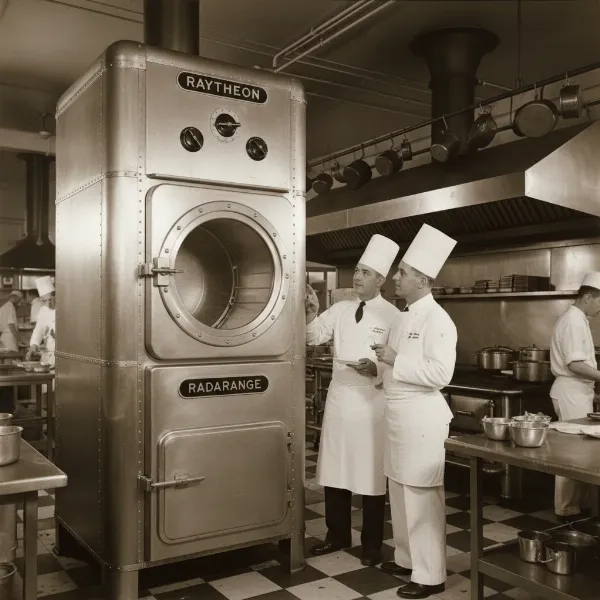 The original Radarange, a massive industrial microwave oven, in a commercial kitchen setting.
Shrinking the Behemoth: Towards the Home Kitchen
The challenge lay in making microwave technology accessible and affordable for the average consumer. This required significant engineering advancements to reduce both the physical size and the manufacturing cost of the magnetron and the overall oven unit. Throughout the 1950s and early 1960s, engineers focused on these crucial aspects. Companies like Tappan, which introduced the first domestic countertop microwave oven in 1965, played a pivotal role in this transition.
These earlier domestic models were still relatively large and expensive compared to conventional ovens, typically costing around $500, which was a substantial investment for most families at the time. Despite the price barrier, the convenience factor began to gain traction. The ability to cook food significantly faster than traditional methods, along with the novelty of the technology, slowly started to pique public interest. This period laid the groundwork for the impending microwave revolution.
The Microwave Revolution Takes Hold: A Kitchen Icon
The real breakthrough for the microwave oven in the consumer market occurred in the 1970s. As production costs decreased and manufacturing processes became more efficient, prices dropped dramatically, making the appliance more attainable for the middle class. By the end of the decade, millions of American homes had a microwave oven. This surge in popularity was also fueled by changing lifestyles; with more women entering the workforce, there was an increasing demand for quick, convenient meal solutions.
The rise of the microwave oven coincided perfectly with the explosion of frozen and pre-packaged convenience foods. Manufacturers began developing specific “microwaveable” meals, further cementing the appliance’s role as a time-saving tool in busy households. It transformed meal preparation, enabling instant reheating, rapid defrosting, and quick cooking of simple dishes, forever altering the landscape of the modern kitchen and dining habits.
Innovations and Evolution: Modern Microwave Ovens
Since its widespread adoption, the microwave oven has continued to evolve, incorporating a range of features and technological advancements. Early models were basic, offering little more than on/off functionality and a timer. Modern microwaves, however, boast an array of sophisticated options:
- Inverter Technology: Introduced to provide a consistent, continuous power level, allowing for more even cooking and precise defrosting, unlike older models that cycled power on and off.
- Combination Ovens: Many contemporary microwaves now combine microwave cooking with convection heating or grilling elements, expanding their utility to baking, roasting, and crisping foods.
- Smart Features: Integration with smart home systems, voice control, pre-programmed settings for specific foods, and even connectivity to recipe apps are becoming increasingly common.
- Sensor Cooking: Built-in sensors can detect humidity and temperature levels to automatically adjust cooking time and power, preventing over- or under-cooking.
- Design and Aesthetics: From sleek stainless steel to retro colors, microwave ovens have also become a statement piece, blending seamlessly with diverse kitchen decors.
Beyond the Kitchen: Unexpected Uses of Microwave Technology
While the kitchen remains its most recognized domain, microwave technology has a surprising breadth of applications beyond heating food. Its ability to generate heat and interact with various materials has found utility in numerous industrial, medical, and scientific fields.
For instance, microwaves are used in industrial processes for drying lumber and ceramics, curing rubber, and even in pest control to sterilize grain. In the medical field, microwave ablation is a technique used to destroy cancerous tumors by heating them to high temperatures. Scientists also employ microwave energy in laboratories for material synthesis, chemical reactions, and plasma generation, showcasing the versatility and continued importance of this energy form in diverse sectors.
The Enduring Legacy and Future
The microwave oven, born from an accidental discovery during wartime research, has traversed a remarkable path to become one of the most transformative kitchen appliances of the 20th century. Its journey from a colossal industrial machine to a compact, feature-rich device illustrates the power of innovation driven by both technological possibility and consumer demand for convenience.
Looking ahead, the future of microwave technology promises further integration with smart home ecosystems, enhanced energy efficiency, and potentially new applications that extend its capabilities beyond simple heating. As our lives continue to accelerate, the microwave oven will undoubtedly maintain its essential role, adapting to new culinary trends and technological landscapes, ensuring its place as a cornerstone of modern convenience.
Frequently Asked Questions
Who invented the microwave oven?
|
Our Picks for the Best Microwave oven in 2026
As an Amazon Associate I earn from qualifying purchases.
|
||
| Num | Product | Action |
|---|---|---|
| 1 | COMFEE' Retro Small Microwave Oven With Compact Size, 9 Preset Menus, Position-Memory Turntable, Mute Function, Countertop Microwave For Small Spaces, 0.7 Cu Ft/700W, Green, AM720C2RA-G |

|
| 2 | COMFEE CMO-C20M1WH Retro Microwave with 11 power levels, Fast Multi-stage Cooking, Turntable Reset Function Kitchen Timer, Speedy Cooking, Weight/Time Defrost, Memory function, Children Lock, 700W |
|
| 3 | Chefman Countertop Microwave Oven 0.7 Cu. Ft., 700 Watts with 10 Power Levels, 6 Cooking Presets with One-Touch Express Cook, Eco Mode, Child Safety Lock, & Mute Button - Black |
|
| 4 | TOSHIBA EM131A5C-SS Countertop Microwave Ovens 1.2 Cu Ft with 12.4" Removable Turntable Smart Humidity Sensor, 12 Auto Menus Mute Function ECO Mode Easy Clean Interior, 1000W, Silver |
|
| 5 | GASLAND 30 Inch Over-the-Range Microwave Oven, 1.7 Cu.Ft Over Stove Microwave, 1000W with 10 Power Levels, Sensor & One-Touch Cooking, 300 CFM Venting, LED Cooktop Light, Black Kitchen Microwave |
|
| 6 | COMFEE' Retro Small Microwave Oven With Compact Size, 9 Preset Menus, Position-Memory Turntable, Mute Function, Countertop Perfect For Spaces, 0.7 Cu Ft/700W, Cream, AM720C2RA-A |
|
| 7 | COMFEE' EM720CPL-PMB Countertop Microwave Oven with Sound On/Off, ECO Mode and Easy One-Touch Buttons, 0.7cu.ft, 700W, Black |
|
| 8 | BLACK+DECKER EM720CB7 Digital Microwave Oven with Turntable Push-Button Door, Child Safety Lock, 700W, Stainless Steel, 0.7 Cu.ft |
|
| 9 | COMFEE' Retro Small Microwave Oven With Compact Size, 9 Preset Menus, Position-Memory Turntable, Mute Function, Countertop, Perfect For Small Spaces, 0.7 Cu Ft/700W, Red, AM720C2RA-R |
|
| 10 | TOSHIBA EM131A5C-BS Countertop Microwave Ovens 1.2 Cu Ft, 12.4" Removable Turntable Smart Humidity Sensor 12 Auto Menus Mute Function ECO Mode Easy Clean Interior Black Color 1000W |
|
The microwave oven was invented by Percy Spencer, an American self-taught engineer who worked for Raytheon. His discovery was accidental, occurring while he was working on magnetrons for radar systems during World War II.
When was the microwave oven invented?
Percy Spencer’s accidental discovery of microwave heating occurred in 1945. The first commercial microwave oven, the Radarange, was introduced by Raytheon in 1947, though consumer models didn’t become widely available until the 1960s and 70s.
What was the first microwave oven called?
The first commercial microwave oven, introduced shortly after its invention, was named the “Radarange” by Raytheon. It was a massive, expensive machine primarily used in industrial and commercial settings.
How did the microwave oven get its start?
The microwave oven got its start from an accidental observation by Percy Spencer. He noticed a chocolate bar in his pocket melted while he was working near an “active magnetron tube”, a component used in radar systems, leading to experiments with food.
Why was the microwave oven so expensive initially?
The initial Microwave Ovens, such as the Radarange, were expensive due to their large size, the complex technology involved in their construction (especially the magnetron), and the limited scale of production. They were primarily designed for industrial use rather than mass consumer markets.