Few kitchen warnings are as ingrained as the admonition to never put metal in a microwave. The dramatic light show of sparks and crackling sounds is enough to deter anyone. Yet, with modern advancements, some metal items are now deemed “microwave-safe,” blurring the lines of this long-standing rule. Understanding the science behind this phenomenon is key to safe and effective microwave use, clarifying why certain metals are indeed dangerous while others pose no threat.
The Science of Microwaves and Metal
To grasp why metal reacts so dramatically in a microwave, it’s essential to understand how these ubiquitous kitchen appliances work. Microwave ovens utilize electromagnetic waves, specifically microwaves, to heat food. These waves penetrate food and cause the water molecules within it to rapidly vibrate, generating friction and, consequently, heat. This molecular agitation is what quickly warms your leftovers or cooks your meals.
However, metal behaves very differently when exposed to these waves. Unlike food, which absorbs microwave energy, metal reflects it. This reflection is precisely why the interior walls of your microwave oven are made of metal. The metal cavity acts like a Faraday cage, trapping the microwaves inside and allowing them to bounce around, ensuring that the energy remains concentrated within the cooking chamber to heat your food efficiently. The smooth, grounded surfaces of the oven’s interior are designed to manage this reflective process safely.
Why Metal Sparks: The Phenomenon of Arcing
The immediate danger of placing certain metals in a microwave stems from a process called “arcing,” often seen as sparks or mini lightning bolts. Metals are excellent electrical conductors, meaning they contain a network of free-moving electrons. When microwaves bombard a metal object, they induce electrical currents and cause these electrons to rapidly oscillate.
The problem arises when these electrons encounter sharp edges, pointed ends, or crumpled surfaces, such as the tines of a fork, the sharp wrinkles of aluminum foil, or metallic trim on dinnerware. At these points, the rapidly oscillating electrons become highly concentrated. This intense buildup of charge can become so extreme that it overwhelms the insulating properties of the surrounding air, ionizing it and creating an electrical discharge, or plasma. This discharge manifests as the bright, audible sparks you observe. Imagine a tiny thunderstorm contained within your appliance.
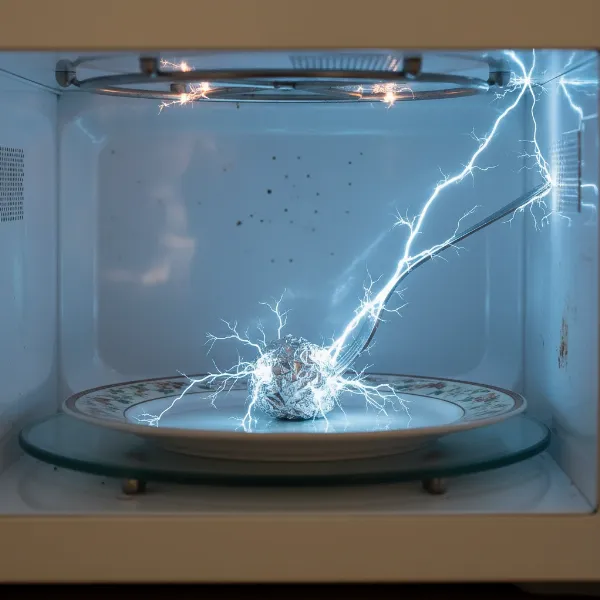 Sparks and arcing inside microwave from metal, illustrating the dangerous electrical discharge.
The Dangers of Microwaving Metal
The dramatic arcing caused by metal in a microwave is not just a visual spectacle; it poses several significant risks.
- Fire Hazard: The extreme heat generated by electrical arcs can ignite any flammable materials inside the microwave, such as paper, plastic containers, or even food itself, leading to a kitchen fire.
- Damage to the Microwave Oven: Repeated arcing can severely damage the microwave’s interior coating, potentially burning holes or scorching the internal waveguide. More critically, it can harm the magnetron, the component responsible for generating the microwaves, significantly shortening the appliance’s lifespan or rendering it inoperable.
- Uneven Cooking or No Heating: Because metal reflects microwaves, any food directly shielded by a metal object will not be properly exposed to the waves and will either cook unevenly or not heat at all. The energy is reflected away from the food, reducing cooking efficiency.
When Can Metal Be Safe in a Microwave?
While the general rule of thumb is “no metal,” this isn’t an absolute truth. Some metal items are specifically designed for or can safely withstand microwave exposure under certain conditions. The key distinction lies in the metal’s shape and thickness.
- Thick, Smooth, Rounded Metal: Objects like a smooth metal spoon placed in a bowl of liquid-rich food, or the permanent metal racks found in some microwave ovens, are generally safe. Their smooth, rounded surfaces prevent the extreme concentration of electrons that leads to arcing. When a spoon is surrounded by food, the microwaves have absorbent material to interact with, further reducing the risk.
- Specially Designed Microwave-Safe Metal Containers: You might have noticed some pre-packaged frozen meals or specialty cookware with metal trays or components that are explicitly labeled “microwave-safe.” These items are engineered with smooth, rounded edges and specific metal alloys (like certain grades of stainless steel) to dissipate electrical charges safely, preventing arcing. Always check the manufacturer’s instructions for such products.
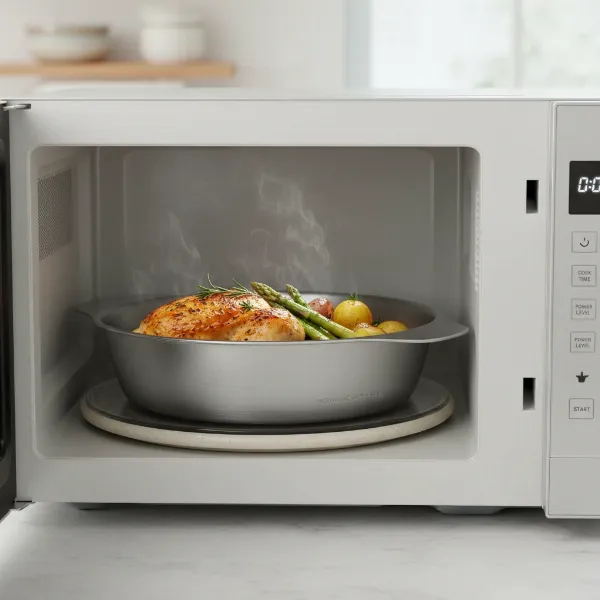 Microwave-safe metal container with smooth edges, holding food, illustrating safe metal use.
 - Aluminum Foil (Used Carefully): Thin aluminum foil is often considered dangerous, but it can be used sparingly and strategically. Small, flat pieces of foil can be used to shield specific areas of food (like the wings of a chicken) from overcooking, provided they are kept flat, not crumpled, and are not close to other metal objects or the microwave walls. The foil must be completely smooth to avoid creating points for charge buildup.
How to Safely Use Metal in a Microwave (If Applicable)
For the rare instances where metal might be permissible, always prioritize safety:
- Consult Your Manual: The microwave oven’s user manual is your primary guide. It will specify if any metal accessories are included or if certain types of metal are approved for use.
- Maintain Distance: If using a microwave-safe metal item, ensure it is placed centrally and has ample space from the microwave walls and other metal components.
- Inspect for Smoothness: Only use metal items that are completely smooth, free of scratches, dents, or sharp edges.
- Monitor Closely: Even with approved metal items, always supervise the microwave during operation. If you observe any sparking, arcing, or unusual noises, immediately stop the microwave by opening the door or pressing the stop button.
What to Avoid at All Costs
To prevent damage to your appliance and potential fire hazards, unequivocally avoid placing the following in your microwave:
- Forks, Knives, and Other Utensils: Their sharp tines and edges are prime candidates for electron concentration and arcing.
- Crumpled Aluminum Foil: Even small crumpled pieces create numerous sharp points, making them highly dangerous.
- Dishes with Metallic Trim: Plates, bowls, or cups with gold, silver, or platinum bands, or metallic glazes, will almost certainly arc.
- Wire Twist Ties: Often found on bread bags, these thin wires will spark intensely.
- Unapproved Metal Containers: Standard tin cans, stainless steel pots, or travel mugs not explicitly labeled “microwave-safe” should never be used.
Conclusion: Understanding the Nuances of Metal and Microwaves
The notion of “no metal in the microwave” is a critical safety rule, largely rooted in the fundamental physics of how microwaves interact with conductive materials. The spectacular sparks and potential for fire and damage are a direct consequence of microwaves inducing electron movement and concentrating charges at sharp metallic points. However, the world of microwave safety is not entirely black and white. With the advent of specially designed containers and a deeper understanding of the principles at play, some smooth, rounded metal objects can indeed coexist safely with your microwave, provided you adhere strictly to safety guidelines and manufacturer recommendations.
Ultimately, your best defense is knowledge and caution. When in doubt, always opt for microwave-safe glass, ceramic, or plastic containers, and save the dramatic light shows for a different setting. What everyday kitchen item have you always wondered about microwaving, but were too afraid to try?
Frequently Asked Questions
Can I put a metal spoon in the microwave?
|
Our Picks for the Best Microwave oven in 2026
As an Amazon Associate I earn from qualifying purchases.
|
||
| Num | Product | Action |
|---|---|---|
| 1 | COMFEE' Retro Small Microwave Oven With Compact Size, 9 Preset Menus, Position-Memory Turntable, Mute Function, Countertop Microwave For Small Spaces, 0.7 Cu Ft/700W, Green, AM720C2RA-G |

|
| 2 | TOSHIBA EM131A5C-SS Countertop Microwave Ovens 1.2 Cu Ft with 12.4" Removable Turntable Smart Humidity Sensor, 12 Auto Menus Mute Function ECO Mode Easy Clean Interior, 1000W, Silver |
|
| 3 | COMFEE' Retro Small Microwave Oven With Compact Size, 9 Preset Menus, Position-Memory Turntable, Mute Function, Countertop, Perfect For Small Spaces, 0.7 Cu Ft/700W, Red, AM720C2RA-R |
|
| 4 | COMFEE' Retro Small Microwave Oven With Compact Size, 9 Preset Menus, Position-Memory Turntable, Mute Function, Countertop Perfect For Spaces, 0.7 Cu Ft/700W, Cream, AM720C2RA-A |
|
| 5 | BLACK+DECKER EM720CB7 Digital Microwave Oven with Turntable Push-Button Door, Child Safety Lock, 700W, Stainless Steel, 0.7 Cu.ft |
|
| 6 | GASLAND 30 Inch Over-the-Range Microwave Oven, 1.7 Cu.Ft Over Stove Microwave, 1000W with 10 Power Levels, Sensor & One-Touch Cooking, 300 CFM Venting, LED Cooktop Light, Black Kitchen Microwave |
|
| 7 | COMFEE CMO-C20M1WH Retro Microwave with 11 power levels, Fast Multi-stage Cooking, Turntable Reset Function Kitchen Timer, Speedy Cooking, Weight/Time Defrost, Memory function, Children Lock, 700W |
|
| 8 | COMFEE' EM720CPL-PMB Countertop Microwave Oven with Sound On/Off, ECO Mode and Easy One-Touch Buttons, 0.7cu.ft, 700W, Black |
|
| 9 | TOSHIBA EM131A5C-BS Countertop Microwave Ovens 1.2 Cu Ft, 12.4" Removable Turntable Smart Humidity Sensor 12 Auto Menus Mute Function ECO Mode Easy Clean Interior Black Color 1000W |
|
| 10 | Chefman Countertop Microwave Oven 0.7 Cu. Ft., 700 Watts with 10 Power Levels, 6 Cooking Presets with One-Touch Express Cook, Eco Mode, Child Safety Lock, & Mute Button - Black |
|
A smooth metal spoon can often be placed in a microwave, especially if it’s submerged in a significant amount of liquid or food. The key is its smooth, rounded shape, which prevents the concentration of electrical charges that cause sparking. However, always monitor closely and remove if any arcing occurs.
Why are microwave walls metal if metal is dangerous?
The interior of a microwave oven is metal because metal reflects microwaves, trapping them inside the cavity to heat food efficiently. The smooth, grounded surfaces of the oven walls are designed to prevent the charge buildup and arcing that occurs with small, pointed metal objects.
What happens if I accidentally microwave metal?
If you accidentally microwave metal, you will likely observe sparks or arcing, hear crackling sounds, and possibly see smoke. Immediately stop the microwave by opening the door or pressing the stop button. This helps prevent fire, damage to the appliance’s interior, and potential harm to the magnetron.
Can aluminum foil go in the microwave?
Aluminum foil can be microwaved, but only with extreme caution. It must be kept flat, used in small pieces, and kept far away from the microwave walls and other metal objects. Crumpled or wrinkled foil, or large sheets, will almost certainly cause dangerous arcing.
Are there truly “microwave-safe” metal containers?
Yes, some metal containers, especially those made from certain grades of stainless steel and designed with smooth, rounded edges, are specifically engineered and tested to be microwave-safe. These are often found in pre-packaged meals or specialty kitchenware. Always look for explicit “microwave-safe” labeling and follow manufacturer instructions.